John Hutchison & Ronnie
Milione
The Philadelphia Experiment
Recreated!
NAVY RADAR SYSTEMS
SMART-L Radar
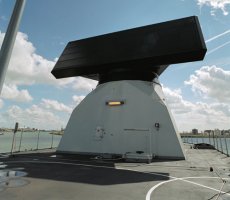
Picture: Antenna of the SMART-L |
|
Manufacturer: Thales Naval Nederland
(former: Hollandse Signaalapparaten BV SIGNAAL)
SMART-L (Signaal Multibeam Acquisition Radar for Targeting)
is the D- Band (former L- Band) long range surveillance radarversion of the successful family of SMART
multibeam 3D radars. It is designed according to NATO specifications for
a Volume Search Radar. Designed to fulfil:
- Medium range detection of the newest generation of small
�stealth� air targets
- Long range detection of conventional aircraft
- High ECCM performance
- Guidance support for patrol aircraft
- Surface surveillance
|
Due to its larger power budget, SMART-L is
dedicated for the early detection and tracking of very small aircraft and
missiles. The accurate 3D target information, gathered by the SMART-L radar, provides an essential contribution to the threat evaluation process,
especially in multiple attack scenarios and it allows the weapon control system
to perform the fastest lock-on.
The phased array antenna consists of a stack of 24 linear
arrays. All 24 arrays are used during reception while 16 arrays are used during
transmission. By controlling the phase of the RF energy, connected to the 16
elements, the illumination pattern can be controlled and level stabilized. The
received radar energy is processed by 24 receiver channels and fed to a
beamforming network in which 14 beams are formed in the elevation coverage from
0 to 70�. The output signals of the beam-former are further processed by a
Doppler processor for the extraction of the target Doppler speed for clutter
rejection and fast but reliable track initiation and maintenance of up to 1000
air targets. Clutter map and jamming map allow the detection and tracking of
tangential flying targets and jammers. Surface surveillance is performed by an D- Band surface surveillance channel capable of automatic detection
and tracking of up to 100 surface targets. Tracking data is transferred to the
command and control system and high quality plot data to a MFR or MTTR.
Main characteristics
- Fully automatic detection, track initiation and
tracking in 3D for air targets
- Mission selectable illumination patterns including a
burn through pattern
- Fast reaction mode for the initiation of cued search
by MFR or MTTR
- Low antenna side lobes in azimuth and elevation
inclusive adaptive nulling against side lobe and main lobe jamming
- Automatic least jammed frequency and deceptive
waveform operation
- Integrated surface surveillance
- Solid state transmitter
- Electronic stabilization
- Automatically functioning built-in test facilities (BITE).
Specifications
| frequency: |
lower D- Band |
| pulse repetition time (PRT): |
|
| pulse repetition frequency (PRF): |
|
| pulsewidth (PW): |
|
| receive time: |
|
| dead time: |
|
| peak power: |
|
| average power: |
|
| displayed range: |
250 nautical miles |
| range resolution: |
|
| beamwidth: |
2.2 degrees |
| hits per scan: |
|
| antenna rotation: |
12 rpm. |
  |