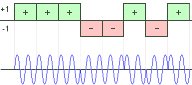
This is a method which combines the
high energy of a long pulse width with the high resolution of a
short pulse width. The pulse is frequency modulated, which
provides a method to further resolve targets which may have
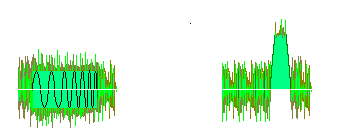
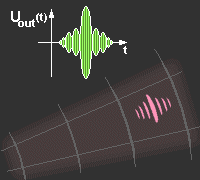
overlapping returns. The pulse structure is shown in the
figure 1.
| Since each part of the pulse has unique frequency,
the returns can be completely separated.
This
modulation or coding can be either
- FM (frequency modulation)
- linear (chirp radar) or
- non-linear or
- PM (phase modulation).
|
|
Figure 1: separation of
frequency modulated pulses |
Now the receiver is able to
separate targets with overlapping of noise. The received echo is
processed in the receiver by the compression filter. The
compression filter readjusts the relative phases of the
frequency components so that a narrow or compressed pulse is
again produced. The radar therefore obtains a better maximum
range than it is expected because of the conventional radar
equation.
The ability of the receiver to
improve the range resolution over that of the conventional
system is called the pulse compression ratio (PCR). For
example a pulse compression ratio of 50:1 means that the system
range resolution is reduced by 1/50 of the conventional system.
Alternatively, the factor of
improvement is given the symbol PCR, which can be used as a
number in the range resolution formula, which now becomes:
Rres = c0 � Pw � ( 2 � PCR)
The compression ratio is equal to
the number of sub pulses in the waveform, i.e., the number of
elements in the code. The range resolution is therefore
proportional to the time duration of one element of the code.
The maximum range is increased by the PCR.
The minimum range is not improved
by the process. The full pulse width still applies to the
transmission, which requires the duplexer to remained aligned to
the transmitter throughout the pulse. Therefore Rmin is unaffected.
| Advantages |
Disadvantages |
lower pulse-power
therefore suitable for Solid-State-amplifier |
high wiring effort |
| higher maximum range |
bad minimum range |
| good range resolution |
time-sidelobes |
| better jamming immunity |
|
| difficulties reconnaissance |
|
Pulse compression with linear FM
waveform
At this pulse compression method
the transmitting pulse has a linear FM waveform. This has the
advantage that the wiring still can relatively be kept simple.
However, the linear frequency modulation has the disadvantage
that jamming signals can be produced relatively easily by
so-called �Sweeper�.
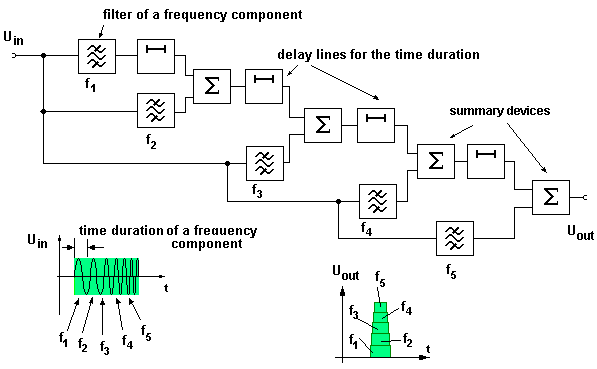
The block diagram on the picture
illustrates, in more detail, the principles of a pulse
compression filter.
Figure 1:
Block diagram
The compression filter are simply
dispersive delay lines with a delay, which is a linear function
of the frequency. The compression filter allows the end of the
pulse to �catch up� to the beginning, and produces a narrower
output pulse with a higher amplitude.
As an example of an application
of the pulse compression with linear FM waveform the RRP-117 can be mentioned.
Filters for linear FM pulse
compression radars are now based on two main types.
- Digital processing (after an
A/D- conversion).
- Surface acoustic wave
devices.
Time-Side-Lobes
The output of the compression filter consists of
the compressed pulse accompanied by responses at
other times (i.e., at other ranges), called time or
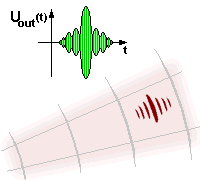
range sidelobes. The figure shows a view of the
compressed pulse of a chirp radar at an oscilloscope
and at a ppi-scope sector.
Amplitude weighting of the output signals may be
used to reduce the time sidelobes to an acceptable
level. Weighting on reception only results a filter
�mismatch� and some loss of signal to noise ratio.
The sidelobe levels are an important parameter
when specifying a pulse compression radar. The
application of weighting functions can reduce time
sidelobes to the order of 30 db's. |
Figure 2: View of the
Time-Side-Lobes |
Pulse compression with non-linear FM
waveform
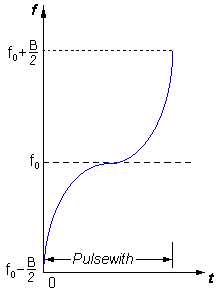
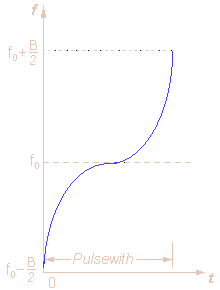
The non-linear FM waveform has
several distinct advantages. The non-linear FM waveform requires
no amplitude weighting for time-sidelobe suppression since the
FM modulation of the waveform is designed to provide the desired
amplitude spectrum, i.e., low sidelobe levels of the compressed
pulse can be achieved without using amplitude weighting.
| Matched-filter reception and low sidelobes become
compatible in this design. Thus the loss in
signal-to-noise ratio associated with weighting by
the usual mismatching techniques is eliminated.
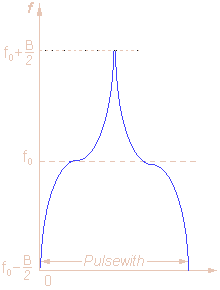
A
symmetrical waveform has a frequency that increases
(or decreases) with time during the first half of
the pulse and decreases (or increases) during the
last half of the pulse. A non symmetrical waveform
is obtained by using one half of a symmetrical
waveform.
The disadvantages of the non-linear FM waveform
are
- Greater system complexity
- The necessity for a separate FM modulation
design for each type of pulse to achieve the
required sidelobe level.
|
|
Phase-Coded Pulse Compression
Phase-coded waveforms differ from
FM waveforms in that the long pulse is sub-divided into a number
of shorter sub pulses. Generally, each sub pulse corresponds
with a range bin. The sub pulses are of equal time duration;
each is transmitted with a particular phase. The phase of each
sub-pulse is selected in accordance with a phase code. The most
widely used type of phase coding is binary coding.
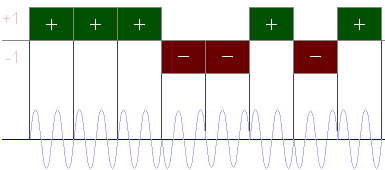
| The binary code consists of a sequence of either +1
and -1. The phase of the transmitted signal
alternates between 0 and 180� in accordance with the
sequence of elements, in the phase code, as shown on
the picture. Since the transmitted frequency is
usually not a multiple of the reciprocal of the sub
pulsewidth, the coded signal is generally
discontinuous at the phase-reversal points. |
|
Picture 1: diagram of a
phase-coded pulse compression |
| The selection of the so called random 0, π phases is
in fact critical. A special class of binary codes is
the optimum, or Barker, codes. They are optimum in
the sense that they provide low sidelobes, which are
all of equal magnitude. Only a small number of these
optimum codes exist. They are shown on the beside
table. A computer based study searched for Barker
codes up to 6000, and obtained only 13 as the
maximum value.
It will be noted that there are none greater than
13 which implies a maximum compression ratio of 13,
which is rather low. The sidelobe level is -22.3 db.
|
|
Length of
code n |
Code elements |
Peak-sidelobe
ratio, db |
| 2 |
+- |
-6.0 |
| 3 |
++- |
-9.5 |
| 4 |
++-+ , +++- |
-12.0 |
| 5 |
+++-+ |
-14.0 |
| |
|
|
| 7 |
+++--+- |
-16.9 |
| |
|
|
| 11 |
+++---++--+- |
-20.8 |
| 13 |
+++++--++-+-+ |
-22.3 |
|
Table: Barker Codes |